
AnimeFeedFlux
Feeds that write themselves.
live · v0.2.0A feed generator: describe the feed you want in a sentence, and it publishes on a schedule to any reader you already use.
A recipe carries a prompt, a schedule, a model and a budget. It runs on time, writes the items, and publishes them at a stable address as RSS, Atom and JSON Feed — so the thing you subscribe to is an ordinary feed, and nothing downstream has to know a model wrote it. The whole product surface is one sentence: a URL that returns valid XML and never lies.
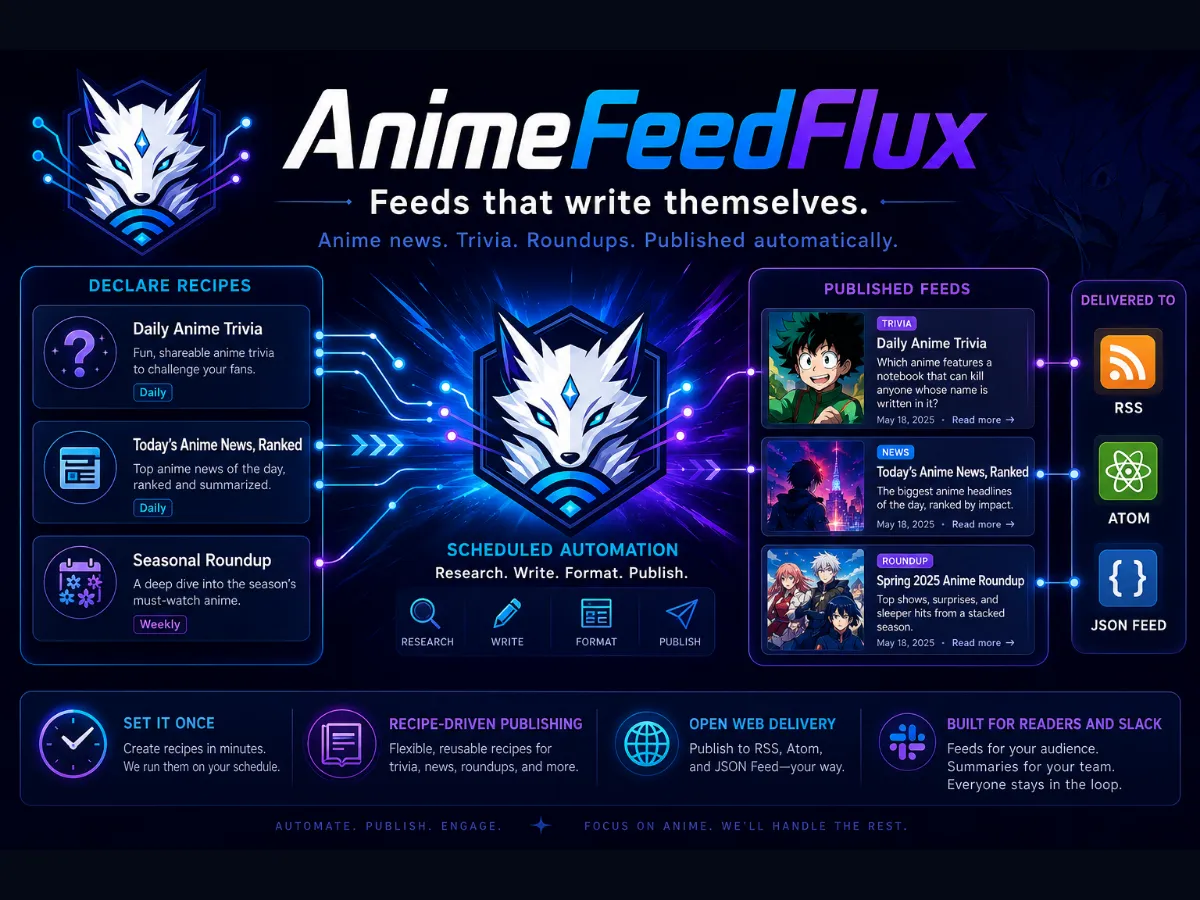
Brand artwork for AnimeFeedFlux. The product is live; the poster is a design exercise, not a claim.
What you get.
Describe a feed, get a URL
A recipe is a prompt, a schedule, a model and a spend cap. What comes out is an ordinary feed address that Slack, or any reader, can subscribe to without knowing a model wrote it.
Two kinds of item, separated by design
Generative items — trivia, on-this-day — are written by the model, which is the source. Grounded items — news, releases — are only edited by it; the facts and the links come from the publisher. Conflating the two is named in the plan as the main way the project fails, so they are split at the architecture level rather than by convention.
Corrections, not silent edits
A reader that has already seen an item never re-fetches it, so editing one reaches nobody. Corrections are published as new items instead, which is the only version a subscriber will actually receive.
Anime-native, not a general feed bot
The recipes it ships with are the ones an anime audience actually wants: a daily trivia question, the day's news ranked by impact, and a seasonal roundup of what is worth watching.
What it runs on.
Including the two libraries underneath it that are my own work — the framework the interface is written in, and the transport it talks over.
What was actually difficult.
The problems worth describing, and what the measurement said. Not the technology list — that is above.
Making a hallucinated link unpublishable rather than unlikely
The obvious failure of an AI-written news feed is a confident link to a page that does not exist, and prompting is not a defence against it. Sources are fetched first, their URLs normalised once, and only that candidate set is ever shown to the model; a link may be published only if it is byte-equal to a URL that was actually retrieved. An invented URL is not improbable — there is no code path that can emit one.
Slack's RSS app is stricter than the specification, and fails silently
It does not error on a feed it dislikes; it simply stops posting. It needs a date on every item, items in sequence, and no duplicate timestamps — so a news run publishing three items at once would have had two dropped with no signal. It also bookmarks the newest date it has seen, which makes a backdated item invisible forever. That produced real constraints: strictly increasing timestamps enforced by a database constraint, a no-backdating rule, plain-text descriptions with the rich HTML in content:encoded, and trivia answers kept out of the description so a channel preview cannot spoil the question.
Putting the security boundary between two planes instead of inside one
The publish plane is plain HTTPS, GET and HEAD only, unauthenticated, and holds a read-only database handle — a bug in the code path serving the public internet has no writer available to corrupt anything with. Every mutation is a gRPC call on a separate, authenticated, IP-allowlisted control plane. The split is the defence; the authentication is only the lock on the half that can write.
Counted, not estimated.
Figures taken from the repository itself. No line-of-code count — it rewards duplication and every reader knows it.
Where this really is.
The newest of the six, and running in production: the engine, the read-only publish plane and the gRPC control plane with its WebAssembly admin all serve at anime.earlcameron.com, in Docker behind nginx. Releases ship themselves — tagging a version runs the test gate, publishes a container image, and the host rolls it out behind a healthcheck with a recorded rollback point. It was built engine-first, so every screen in the admin drives an RPC the CLI had already exercised. Recipes can declare live web search per feed; the remaining unproven claim is the week-long live Slack soak, which the plan tracks rather than assumes.
These are personal projects, built on nights and weekends with AI agents in the loop — that is how one person ships this much surface area at once. Most of them are early: alpha or prototype, with polish that varies a lot by area. What is not early is the architecture, the test suites, and the measurements — every number on this page is counted from the repository and every claim is one you can check against the code.